
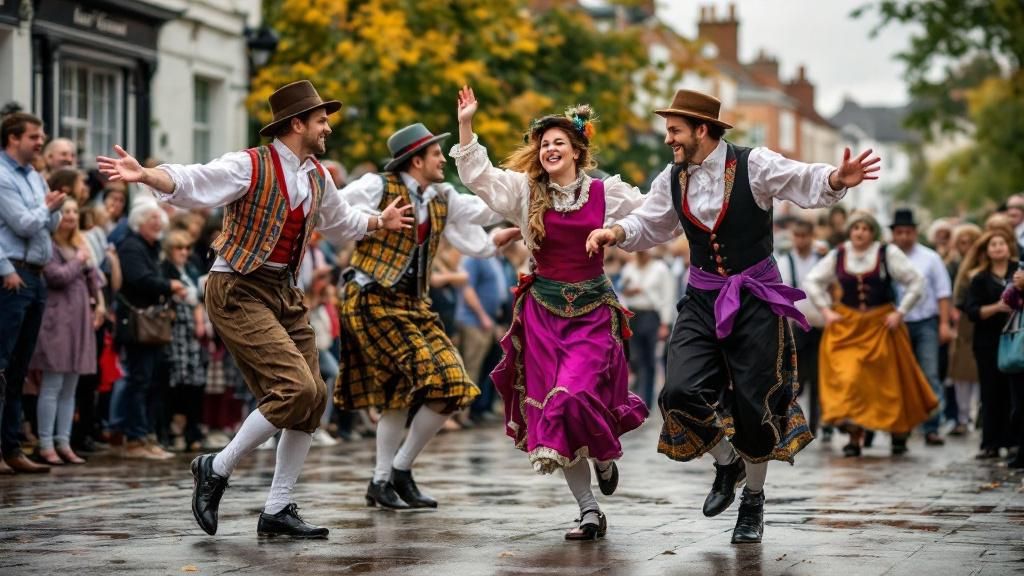
Once overlooked as a nostalgic echo of England’s pastoral past, Morris dancing is experiencing an unexpected revival amongst Britain’s youth. From university societies to country spaces, practitioners aged under thirty are reconnecting with the intricate steps, jingling bells, and bright garments that have shaped this centuries-old tradition. This article examines the factors driving this cultural resurgence, examines how contemporary performers are reinterpreting the form, and considers what this fresh enthusiasm reveals about modern British perspectives towards tradition and social connection.
The Cultural Renaissance of Morris Dancing
The resurgence of Morris dancing amongst young people across Britain reflects a notable departure from years of falling participation. What was once perceived as an exclusively rural or elderly pursuit has evolved into a lively cultural phenomenon, with university societies, metropolitan dance collectives, and local organisations actively embracing the tradition. This revival challenges long-held stereotypes and shows that contemporary youth truly recognise the worth of maintaining and honouring Britain’s folkloric heritage, revitalising practices that seemed destined for obscurity.
This revived interest extends beyond mere nostalgic curiosity; emerging dancers are consciously reimagining Morris dancing for contemporary times. They integrate current musical styles, experiment with creative movement patterns, and create welcoming groups that embrace dancers without regard to heritage or previous training. The trend demonstrates a more expansive cultural transformation wherein young British people deliberately look for genuine links to their ancestral traditions whilst at the same time reshaping what tradition means, fostering a living conversation between historical authenticity and contemporary expression that speaks to their generation’s values.
Why Young Adults Are Embracing This Classic Artistic Practice
Morris dancing’s draw among younger generations transcends nostalgic curiosity. Contemporary dancers embrace the art form’s deep cultural roots whilst recognising its ability to enable creative expression and social connection. The openness of modern Morris groups, paired with their welcoming approach, has transformed the perception of this conventionally closed-off pursuit. Young people are discovering that Morris dancing delivers a meaningful alternative to standard recreational pursuits, affording both demanding physicality and genuine community engagement in an increasingly digital world.
Sense of Community
In an era marked by social fragmentation, Morris dancing groups provide young people with concrete social networks founded on common principles and collaborative practice. The welcoming character of contemporary Morris organisations actively welcomes newcomers irrespective of background or experience, nurturing authentic bonds and social bonds. Participants often describe their dancing cohorts as family units of choice, providing emotional support and a sense of place that stretches well beyond the performance season. This sense of community becomes particularly valuable for young adults navigating university or early career transitions.
The collaborative framework of Morris dancing inherently promotes collective togetherness and shared accountability. Each dancer’s contribution directly impacts the group’s aesthetic coordination and temporal accuracy, creating mutual reliance that deepens social bonds. Many young dancers note that their Morris groups facilitate real friendships in ways that standard social spaces regularly fail to accomplish. The collective dedication to sustaining and advancing this cultural heritage creates a strong feeling of shared mission amongst practitioners.
Exercise and Movement and Overall Wellbeing
Morris dancing demands substantial bodily effort, combining cardiovascular exercise with complex coordination and strength development. Young dancers benefit from improved fitness levels whilst engaging in activity that carries cultural significance rather than merely utilitarian. The repetitive, rhythmic character of Morris footwork provides meditative qualities alongside bodily fitness, enhancing mental wellbeing. Participants commonly mention the comprehensive wellness advantages as a main reason for sustained involvement in their local Morris groups.
Beyond heart health advantages, Morris dancing cultivates body awareness and spatial perception and physical self-assurance, especially beneficial for young people facing body image worries. The emphasis on accuracy and technical skill and collective synchronisation shifts attention away from appearance-based anxiety toward capability and achievement. Furthermore, the open-air staging culture associated with Morris dancing encourages participants to interact with the natural world and the rhythms of the seasons, enhancing mental health through connection with nature and tradition.
Regional Differences and Modern Adaptations
Morris dancing practices differ considerably across Britain’s regions, with each region creating characteristic forms reflecting regional history and geography. The Cotswolds maintain the vigorous, athletic “Cotswold” approach, whilst the North West favours the highly detailed “Northwest” tradition displaying intricate dress and complex patterns. Younger dancers are enthusiastically embracing these regional variations, engaging in instruction and celebrations to learn traditional practices whilst recognising the subtle cultural elements embedded within each practice. This spatial range gives modern dancers with diverse opportunities into Morris dancing, enabling them to relate to heritage rooted in their own communities.
Modern adaptations are concurrently expanding Morris dancing’s reach beyond traditional contexts. Younger practitioners incorporate contemporary music, experimental choreography, and inclusive casting practices, questioning historical gender and age restrictions. All-gender ensembles and LGBTQ+ Morris groups have developed, fundamentally transforming the tradition’s social dynamics. These innovations maintain the essential character—rhythmic footwork, bells, and celebratory spirit—whilst making the practice more approachable and relevant to twenty-first-century participants. Such imaginative reimagining illustrates that heritage traditions needn’t remain static, successfully bridging historical authenticity with modern sensibilities.
The Future of Morris Dancing in Britain
As Morris dancing keeps engaging younger audiences, the tradition stands at a pivotal juncture. Contemporary dancers are consciously redefining the form whilst maintaining its cultural heritage, introducing fresh choreography and inclusive practices that appeal to modern sensibilities. Universities document unprecedented enrolment in Morris societies, whilst festivals draw record crowds of young participants. This momentum suggests the art form is moving beyond nostalgic curiosity to authentic artistic renaissance, establishing sustainable foundations for long-term growth and continued relevance within British communities nationwide.
Looking ahead, Morris dancing’s trajectory appears quite favourable. The combination of social media promotion, straightforward instruction approaches, and younger generations’ appetite for authentic communal bonds creates perfect circumstances for thriving. Organisations are funding mentoring initiatives and area-based tournaments, developing talent pathways and ensuring knowledge transfer between experienced and novice dancers. Should this enthusiasm endure, Morris dancing may finally escape its reputation as exclusively tradition-centred, instead becoming established as a vibrant, evolving cultural practice that substantially enhances contemporary British society and deepens social connections across generations.
